News
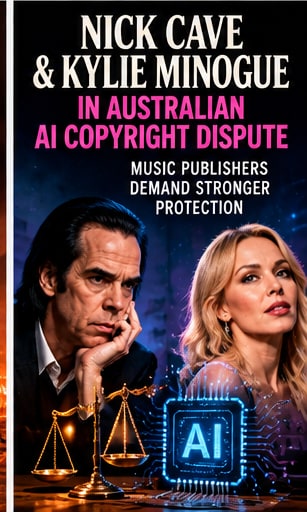
20 October 2026 – Nick Cave and Kylie Minogue Named in Australian AI Copyright Dispute as Music Publishers Demand Stronger Protection
By Editorial Team - October 20, 2026
Summary
Music publishers cite catalog material from Nick Cave and Kylie Minogue in a major Australian debate over commercial AI model training and artist compensation.
Key Facts
- Music catalogues of Nick Cave and Kylie Minogue cited in major Australian AI training copyright inquiry.
- International Confederation of Music Publishers warns loose AI exemptions could exploit artist intellectual property.
- Australian parliamentary representatives urge stronger creator consent and compensation mechanisms.
- Entities: Nick Cave, Kylie Minogue, International Confederation of Music Publishers, Anthony Albanese, Australia, Artificial Intelligence
- Tags: nick-cave, kylie-minogue, ai-copyright, australian-music, music-publishing, icmp, intellectual-property
Australian musicians Nick Cave and pop icon Kylie Minogue have become prominent examples in a developing dispute concerning the use of copyrighted recordings and lyrics to train artificial-intelligence systems. New reporting details concerns raised by the International Confederation of Music Publishers, which argues that Australian copyright policy could leave musicians and publishers exposed to commercial AI training without appropriate permission or compensation.
The organisation represents major music-publishing interests and has warned that technology companies may seek favourable legal environments when developing generative systems. According to the publishers, material associated with Cave and Minogue appeared in examples demonstrating how AI systems can reproduce or generate content connected with existing musical catalogues. These examples have prompted renewed questions about whether the underlying training processes involved appropriately licensed material.
The allegations do not, by themselves, establish that every identified use was unlawful. Australian policymakers are examining the relationship between AI development and copyright protection, with parliamentary representatives recommending further consideration of creators' rights. Prime Minister Anthony Albanese has previously expressed concern about musicians losing control over the commercial exploitation of their work.
For independent artists, the dispute raises questions extending beyond the interests of internationally successful performers. Smaller musicians often depend on relatively modest recording and publishing income, making uncertainty surrounding licensing particularly consequential. The debate also involves transparency, consent and the difficulty of determining which recordings have been incorporated into large training datasets. Artificial intelligence may eventually provide musicians with useful creative tools, but the industry still needs to determine how those tools should interact with existing intellectual property. Apparently teaching a computer about music is considerably easier than persuading everyone involved to agree on who should receive the royalties. Explore our full news coverage for evolving copyright developments.